
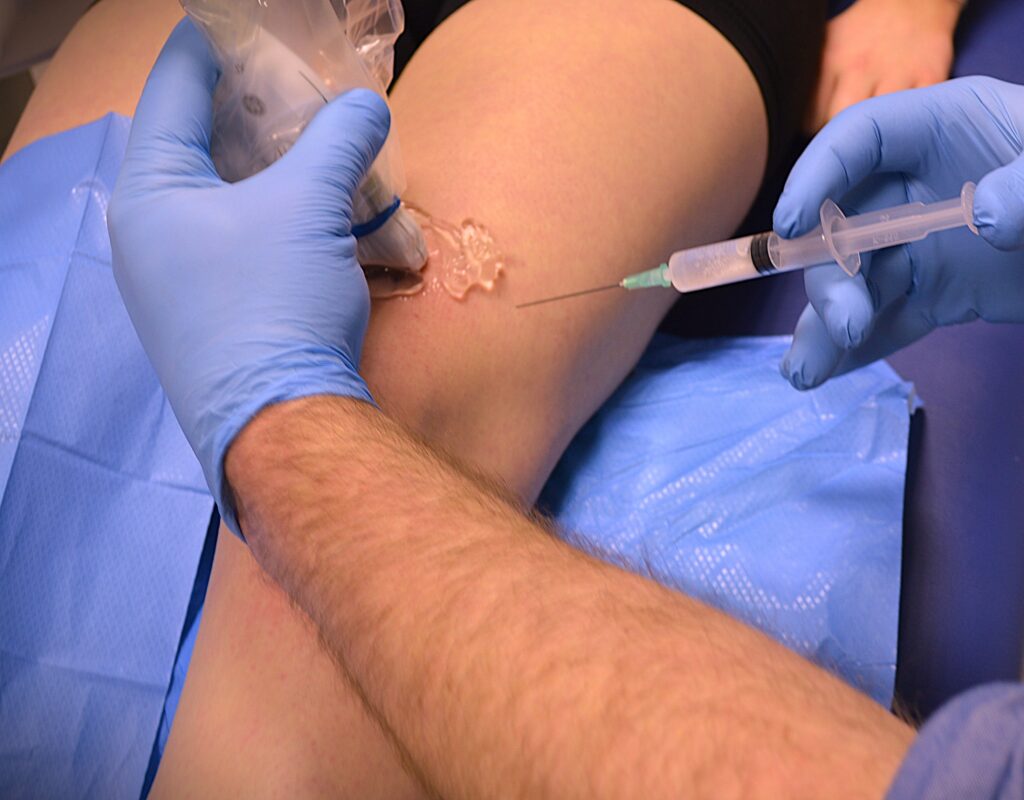
Joint & Soft Tissue Injections
Joint and soft tissue injections can be really helpful in controlling and managing swelling and pain affecting a joint or soft tissue (bursa, nerve, tendon, ligament). These can be used in conjunction with rehabilitation and other treatments to help with movement, pain and restore the ability to exercise. Pain and swelling often limit the progression of rehabilitation and an injection of steroid (cortisone) combined with a local anaesthetic can remove that barrier and allow you to move pain free. This provides a helping hand in progressing with exercise.
Steroid Injection
Steroid injections
Where can i have an injection?
- Knee Osteoarthritis
- Hip OA
- Shoulder pain: Impingement, rotator cuff pain
- Frozen Shoulder
- Thumb arthritis
- Tennis and Golfers elbow
- Carpal Tunnel syndrome
- Some tendinopathies
- ITB Syndrome
- Hand and finger arthritis
- Bursitis
- Trigger finger / Trigger thumb
Hyaluronic Acid injections
The regions to be injected:
- Knee Osteoarthritis
- Hip OA
- Shoulder pain: Impingement, rotator cuff pain
- Shoulder OA
- Thumb arthritis
- Tennis and Golfers elbow
- Patella tendonitis
- ITB Syndrome
- Trigger finger / Trigger thumb
- Ankle arthritis
Hyaluronic Acid Injections for Osteoarthritis
Treatment Benefits
Hyaluronic acid (HA) injections are supported by clinical evidence for reducing pain and improving joint function in osteoarthritis. HA works by restoring the natural lubrication and shock-absorbing properties of synovial fluid, particularly in larger joints like the knee and hip. This can lead to improved mobility and quality of life, with many patients experiencing meaningful symptom relief for at least six months.
Recent research continues to support its effectiveness. A 2023 study of 166 patients receiving a single high-concentration HA injection reported that the majority achieved at least a 50% improvement in pain, stiffness, and function—including walking ability—lasting up to six months.
Who Benefits Most
Hyaluronic acid injections are most effective for individuals with mild to moderate osteoarthritis, particularly those who have not gained sufficient relief from first-line treatments such as pain medication, physiotherapy, or activity modification. It is commonly used for knee osteoarthritis in patients who continue to experience symptoms despite conservative care.
Treatment Timeline and Duration
Safety Profile
Hyaluronic acid injections are well tolerated, with a strong safety profile demonstrated in clinical studies. Side effects are usually mild and temporary, most commonly including localised pain, swelling, or stiffness at the injection site. These effects typically resolve on their own, and systemic reactions are rare.
Arthrosamid® for Knee Osteoarthritis
Mechanism of Action
Arthrosamid® is a 2.5% polyacrylamide hydrogel injection that works by integrating into and thickening the synovial membrane, forming a biological scaffold. Arthrosamid® is an injectable implant and is administered with a single dose of antibiotics. The pain from Osteoarthritis and continual swelling is a result of synovial inflammation. This injection seeks to prevent the inflammation from happening. Less swelling, improved movement and less pain will lead to an improved functioning.
Clinical Effectiveness
Patients often experience pain reduction within 4 weeks, with improved mobility. Clinical studies report success rates above 80%, with significant improvements in pain and function.
Long-Term Benefits
Procedure
A simple, one-step outpatient injection performed under local anaesthetic. No surgery is required, and it is designed as a one-time treatment. Each syringe is 1ml and there are 6 individual syringes.
Safety Profile
Arthrosamid® is well tolerated. Side effects are usually mild and short-lived, including temporary swelling, redness, or discomfort at the injection site. Infection risk is below 1%.
Clinical Evidence
Backed by over 20 years of research, with data from 463 patients showing statistically significant improvements at 52 weeks and beyond.
Who Is It For?
Best suited for patients with moderate knee osteoarthritis, though those with more advanced disease may still benefit. It is ideal for individuals seeking a non-surgical alternative when other treatments have failed.
Comparison to Other Treatments
Unlike hyaluronic acid injections, which typically require repeat treatments every 6–12 months, Arthrosamid® is non-biodegradable and can provide long-lasting relief from a single injection.
Cost Consideration
While more expensive upfront, Arthrosamid® may be cost-effective over time due to its long duration of action and reduced need for repeat treatments.
Risks
Joint injections carry a very low infection risk (<1%). Rare allergic reactions to local anaesthetic can occur. Patients are fully assessed beforehand and may receive antibiotics prior to treatment.
Booking
Patients can book an assessment online or contact the clinic directly. All patients require evaluation before treatment to ensure safety and suitability.
Hydrodilatation for Frozen Shoulder
Sinogel Joint Injections
This injection is for those patients who have mild to moderate osteoarthritis, who want to continue leading an active life and who may not be having the longevity of hyaluronic acid alone. Sinogel is a long acting injection providing additional stability and durability when injected into the knee.
What is Sinogel?
Sinogel contains sodium hyaluronate and sodium chondroitin in a hybrid cooperative complex. It’s a proven treatment for osteoarthritis and similar degenerative conditions of large joints such as the hips. This combination represents an innovative approach that goes beyond traditional single-component hyaluronic acid injections.
What can I expect
We usually find that the knee responds after 7 days and then a further 6 weeks to find maximum benefits.
Aftercare
Unlike other hyaluronic acids, this unique injection can give rise to some stiffness for up to 72 hours. This reaction is thought to be prompted by the presence of sodium chondratin as the joint begins its regenerative process. We recommend a period of rest during this time.