
Why Arthrosamid for Knee Osteoarthritis?
Most injectable treatments for knee osteoarthritis work by temporarily improving conditions inside the joint. Steroid injections suppress inflammation for a matter of weeks. Hyaluronic acid supplements the synovial fluid and typically lasts between 6 and 12 months before a top-up is needed. Both have a place in treatment, but both require patients to return for repeat procedures to maintain relief.
Arthrosamid takes a different approach entirely. Rather than supplementing or suppressing, the hydrogel becomes part of the joint itself. Once injected, it integrates into the synovial membrane, the tissue lining the inside of the knee joint, and reinforces it from within. That structural reinforcement is what produces lasting pain relief from a single procedure, without the cycle of declining benefit and re-treatment that defines other injectables.
The result is meaningful, sustained improvement in pain and function that clinical data show persists for 3 to 5 years in the majority of patients, with some experiencing benefit for up to 8 years.
What Happens During The Procedure?
Arthrosamid is administered as a single outpatient procedure under local anaesthetic. No hospital stay, no general anaesthetic, and no surgical incision.
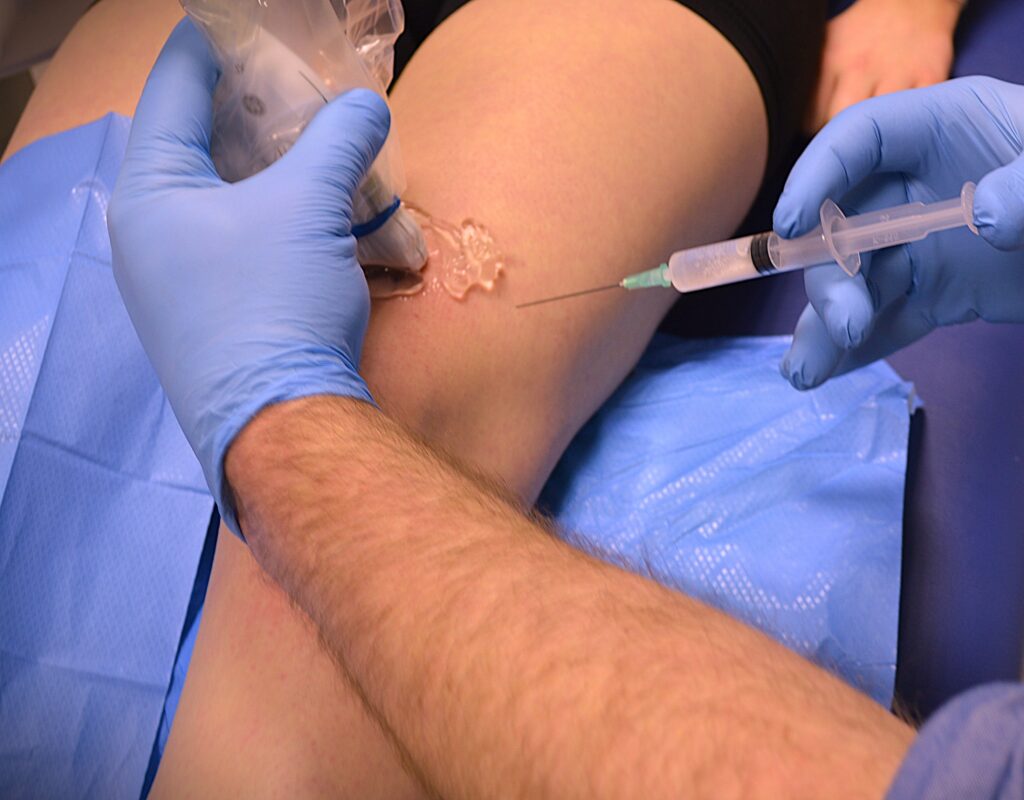
Your clinician delivers six 1 ml syringes of the hydrogel into the knee joint under real-time ultrasound guidance. Ultrasound ensures the injection reaches the correct intra-articular space with precision that cannot be achieved by landmark-guided technique alone. The full appointment, including preparation, the injection itself, and a short observation period afterwards, typically takes between 60 and 90 minutes.
Once inside the joint, the hydrogel does not sit freely in the joint space. It migrates into and integrates with the synovial membrane, forming a stable internal scaffold. This scaffold cushions load-bearing surfaces, dampens the inflammatory processes that drive osteoarthritic pain, and reduces the mechanical stress placed on damaged cartilage and bone during movement and weight-bearing activity.
Because Arthrosamid is non-biodegradable, the scaffold does not break down over time. The protective effect is sustained rather than progressively fading as the body metabolises the treatment, which is what happens with biodegradable alternatives.
Proven Results And What To Expect
What the evidence shows
Arthrosamid is backed by more than 20 years of clinical research across 463 patients. Trial outcomes measured against WOMAC and Patient Global Assessment scales demonstrate statistically significant improvements in both pain reduction and physical function, with success rates exceeding 80%. These are not short-term gains measured at a few weeks post-injection. The published data confirm sustained benefit at 2 years, with real-world outcomes commonly extending well beyond that timeframe.
This depth of evidence sets Arthrosamid apart from newer injectable options that may show early promise but lack the long-term follow-up data needed to confirm durability.
Recovery and timeline
There is no formal recovery period. Most patients can resume normal daily activities within a few days, though high-impact exercise should be reintroduced gradually. Mild swelling or stiffness around the injection site in the first few days is the most commonly reported side effect and typically resolves on its own.
Pain reduction usually begins within the first 4 weeks. Functional improvement then continues to build progressively over the following 3 to 6 months as inflammation subsides and patients gradually increase their activity levels. The full benefit of the treatment becomes apparent as this process completes.
Is Arthrosamid right for you?
Arthrosamid is designed for moderate to moderate-severe knee osteoarthritis. It tends to be most suitable for patients who have already tried steroid or hyaluronic acid injections without achieving lasting relief; those looking for a credible non-surgical alternative to knee replacement; patients who want to avoid the cost, inconvenience, and time commitment of repeat injection cycles; and anyone with a confirmed imaging diagnosis of knee osteoarthritis who wants a single intervention with long-duration benefit.
It is not typically the first-line treatment for mild osteoarthritis where other injectables have not yet been explored, and it is currently approved for knee joints only. Your clinician will confirm suitability at your assessment appointment.
Safety and tolerability
Arthrosamid has an established safety profile supported by over two decades of clinical use. The hydrogel is biocompatible and non-biodegradable, and no systemic adverse reactions have been documented in the published literature. The most frequent side effects are temporary and localised: mild discomfort, slight swelling, or short-lived stiffness at the injection site. Serious complications are rare. Overall, the tolerability profile is comparable to or better than other injectable treatments currently used for knee osteoarthritis.
Your Clinical Assessment in Swansea
We do not offer Arthrosamid on a walk-in basis or without a prior clinical assessment. This is not an administrative step. It is a clinical requirement that protects patients and ensures the treatment is appropriate.
Arthrosamid is indicated for a specific grade of knee osteoarthritis. The degree of cartilage loss, the level of synovial inflammation, and the structural condition of the joint all need to be evaluated before a treatment decision is made. A referral letter or a description of symptoms is not sufficient to make that determination.
At our clinic, your assessment appointment includes a detailed clinical history, a hands-on examination of the affected knee, and a diagnostic ultrasound scan performed on site during the same visit. The ultrasound provides real-time visualisation of the joint, allowing your clinician to assess the degree of synovial change, identify any effusion, and confirm the structural suitability of the knee for Arthrosamid treatment.
If you have existing imaging, such as an MRI or X-ray, we review this alongside our own ultrasound findings to build a complete clinical picture. Where Arthrosamid is appropriate, we confirm this at the assessment and book your treatment appointment. Where it is not, we discuss the alternatives with you directly.
Arthrosamid treatment at our Swansea clinic
Core Body Clinic’s Swansea clinic at 110 Walter Rd, Swansea, SA1 5QQ is fully equipped to deliver Arthrosamid injections under ultrasound guidance. All patients are assessed and treated by advanced practice physiotherapists with specialist training in injectable therapies. We accept all major private medical insurance providers and welcome self-funding patients. Full pricing details are available on our price list page.
No GP referral is required. Book your clinical assessment online or call 01792 369535.
Is the Arthrosamid injection painful?
The knee is numbed with local anaesthetic before the hydrogel is administered, so most patients describe the injection itself as a pressure sensation rather than significant pain. Some mild discomfort or aching around the joint is common for a day or two afterwards, similar to what you might feel after a strenuous workout. This settles on its own and can usually be managed with simple pain relief such as paracetamol if needed.
Who carries out the procedure at your Swansea clinic?
Every treatment at our Swansea clinic is performed by an advanced practice physiotherapist trained in ultrasound-guided injection technique. The same clinician who carries out your diagnostic assessment and ultrasound scan also delivers the injection, so there is continuity throughout your care rather than being passed between different practitioners.
What happens if it does not relieve my symptoms?
Most patients respond well, but no injectable therapy works for everyone. If pain reduction is limited or does not meet expectations after the typical 4 to 6 month window, your clinician will reassess the joint and discuss next steps, which may include further diagnostic imaging, a different treatment approach, or referral for surgical opinion. You are never left without a follow-up plan.
How does Arthrosamid compare to knee replacement surgery?
Arthrosamid is not a substitute for knee replacement in every case, but for many patients with moderate osteoarthritis, it offers a way to delay or avoid surgery altogether. It involves no incision, no hospital stay, and no lengthy post-operative rehabilitation. Recovery from Arthrosamid is measured in days, not months. For patients who are not yet ready for, or wish to postpone, a knee replacement, it provides a clinically supported alternative with years of benefit from one outpatient visit.
Do I need to do anything to prepare for treatment or afterwards?
No special preparation is required before your appointment, though we advise avoiding strenuous activity on the knee for a short period beforehand if possible. After treatment, you can walk and carry out normal daily activities straight away. We recommend easing back into higher-impact exercise gradually over the first couple of weeks and avoiding any activity that causes noticeable discomfort at the injection site.