
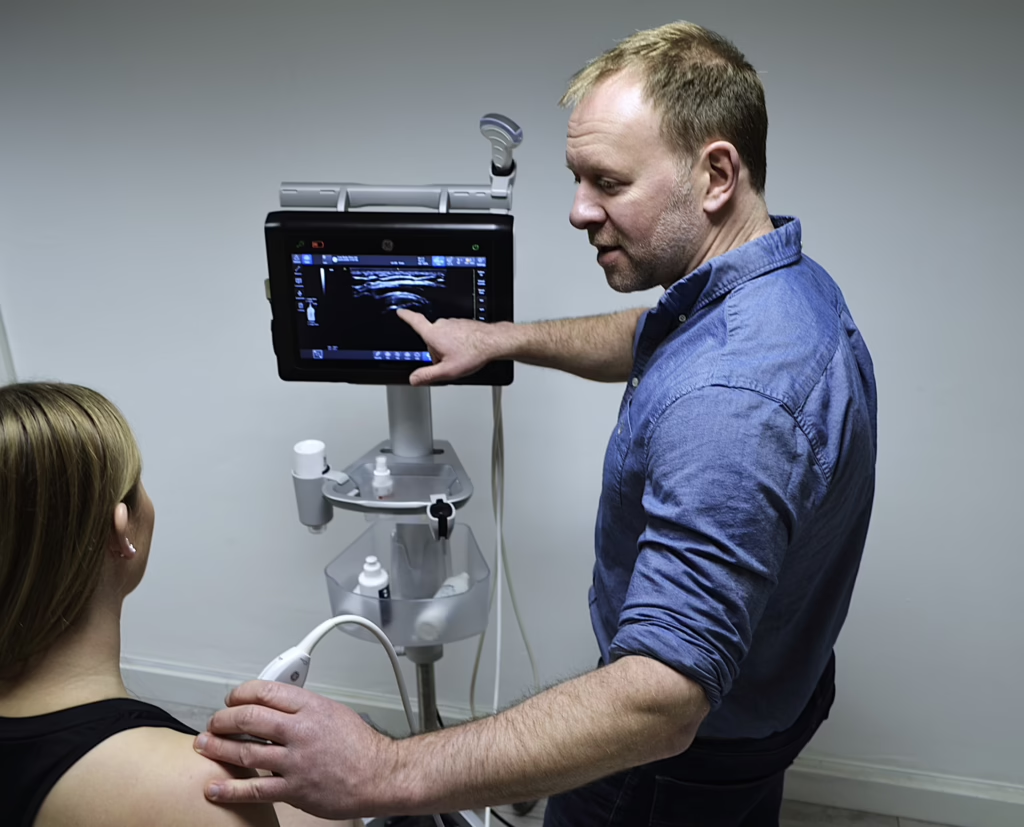
Precision Imaging in Real Time
Diagnostic ultrasound scanning at our Reading clinic operates as point of care ultrasound (POCUS): imaging is performed by the treating clinician in the treatment room during your appointment to answer a specific clinical question, rather than sending you elsewhere and waiting for a report to come back. Tendons, ligaments, bursae, joint capsules, nerves, and musculoskeletal structures all produce distinct imaging appearances under ultrasound. This allows our clinicians to confirm or refute a working diagnosis with a level of precision that fundamentally improves the accuracy of subsequent treatment decisions.
Unlike a standard static MRI, diagnostic ultrasound is performed in real time during your clinical appointment. This allows the clinician to correlate imaging findings directly with your physical symptoms, apply dynamic stress testing to assess live tissue behaviour under load, and guide injection needles to precise anatomical targets with continuous visual confirmation. The result is a diagnostic process that is faster, more clinically integrated, and more immediately actionable than imaging performed remotely and reported separately.
What Is Point of Care Ultrasound (POCUS)?
Point of care ultrasound (POCUS) refers to ultrasound scanning performed by the treating clinician at the point of care, in the treatment room, during your appointment, rather than in a separate radiology department. The clinician performing the scan is the same clinician conducting your assessment, interpreting the images in the context of your physical examination findings, and making treatment decisions based on what they observe in real time.
HOW POCUS DIFFERS FROM STANDARD IMAGING:
In standard healthcare, a clinician suspects a diagnosis, refers the patient for imaging, a radiographer performs the scan, a radiologist reports it, and the report is returned to the referring clinician. This process can take days to weeks and produces a static document rather than a live clinical conversation. POCUS eliminates every stage of that delay.
At Core Body Clinic’s Reading clinic, all diagnostic ultrasound is performed as POCUS by advanced practice physiotherapists with specialist postgraduate training in musculoskeletal imaging. The scan takes place within the clinical appointment, findings are discussed with you immediately, and treatment planning begins at the same session. For patients who have experienced the frustration of fragmented NHS imaging pathways, this represents a clinically and practically superior alternative.
Musculoskeletal Ultrasound at Our Reading Clinic
Musculoskeletal ultrasound at Core Body Clinic’s Reading clinic covers the full range of soft tissue structures affected by injury, degeneration, and inflammatory conditions. Our clinicians use high-frequency ultrasound to produce detailed real-time images of tendons, ligaments, muscles, bursae, joint capsules, and peripheral nerves throughout the body.
The diagnostic value of musculoskeletal ultrasound lies in its ability to detect pathology that does not reliably appear on plain X-ray and that MRI, while highly sensitive, does not always capture in the context of dynamic movement. Ultrasound allows direct visualisation of tendon fibre continuity, the identification of partial and full-thickness tears, the detection of calcific deposits within tendons, the assessment of bursal thickening and fluid accumulation, and the evaluation of joint effusion volume and character.
Dynamic assessment is a particular strength of ultrasound that no other imaging modality can replicate. By moving the joint through a range of motion during scanning, our clinicians can observe tendon behaviour under load, identify impingement that only occurs in specific positions, and assess joint instability in real time. This dynamic capability is especially valuable in shoulder, ankle, and wrist pathology where static imaging frequently underestimates the degree of functional compromise.
CONDITIONS ASSESSED WITH MUSCULOSKELETAL ULTRASOUND AT READING:
- Rotator cuff tears and tendinopathy
- Calcific tendonitis
- Frozen shoulder and glenohumeral joint assessment
- Wrist and hand tendon pathology
- Plantar fasciitis and plantar plate assessment
- Achilles tendon pathology including insertional and mid-portion tendinopathy
- Knee joint effusion, patellar tendinopathy, and meniscal assessment
- Hip bursitis, labral pathology, and greater trochanteric pain syndrome
- Tennis and golfers elbow
- Nerve entrapment including carpal tunnel and cubital tunnel syndrome
- Soft tissue masses and ganglia
Ultrasound-Guided Injection Therapy
One of the most valuable uses of diagnostic ultrasound at our Reading clinic is guiding joint and soft tissue injections.
Traditional landmark-guided injections rely entirely on feeling anatomical surface markings to estimate needle placement, which carries a recognised risk of missing the exact target. In contrast, comparative clinical studies consistently show that utilising live ultrasound guidance significantly improves needle placement accuracy, boosts your therapeutic response rate, and minimises procedural complications.
At The Atrium, every injection administered at our Reading clinic is performed under real-time ultrasound guidance. The clinician visualises the needle tip continuously throughout the procedure, confirming intra-articular or intra-bursal placement before the therapeutic agent is delivered. This eliminates the risk of inadvertent tendon injection, nerve contact, or subcutaneous deposition that reduces the efficacy and safety of landmark-guided technique.
For joint injections, including steroid, hyaluronic acid, Sinogel, Arthrosamid, and hydrodilatation for frozen shoulder, ultrasound guidance is not optional at our Reading clinic. It is a non-negotiable component of the procedure that underpins the quality and safety of every injection we administer.
Further details on the specific injection therapies available at our Reading clinic are available on our joint injections page.
Ultrasound as Part of Your Clinical Assessment
At Core Body Clinic’s Reading clinic, diagnostic ultrasound is integrated into the clinical assessment process rather than offered as a separate appointment. Where ultrasound imaging is indicated, it is performed by the same clinician conducting the assessment, during the same appointment, with findings incorporated immediately into the diagnostic and treatment planning process.
This integrated model produces a qualitatively different clinical experience to the fragmented pathway patients encounter in standard healthcare, where imaging is requested, performed remotely by a sonographer, reported by a radiologist, and returned to the referring clinician days or weeks later. At our Reading clinic, the clinician requesting the scan is also the clinician performing it, interpreting it in the context of the physical examination, and acting on the findings within the same appointment.
This approach is particularly valuable for complex or ambiguous presentations where the correlation between imaging appearance and patient symptomatology requires clinical judgment rather than a standardised radiology report. It also eliminates the delay between diagnosis and treatment initiation that fragmented pathways create.
Who Performs Ultrasound Scanning at Our Reading Clinic?
Diagnostic ultrasound at Core Body Clinic’s Reading clinic is performed by advanced practice physiotherapists with specialist training in musculoskeletal and pelvic ultrasound. These expert clinicians are trained to a postgraduate level in imaging technique, image interpretation, and the practical application of ultrasound findings within a musculoskeletal and pelvic health context.
This clinician-led model differs from the radiographer-led model common in NHS and private radiology settings. In a radiology setting, the person performing the scan and the person interpreting it are typically different individuals, and neither is the clinician responsible for treatment. At our Reading clinic, the clinician performing the scan is directly responsible for your care, combining imaging findings with clinical examination data in real time to produce a diagnostic conclusion that is both accurate and immediately actionable.
Shockwave Therapy for Erectile Dysfunction at Our Reading Clinic
Core Body Clinic’s Reading clinic at The Atrium, Scours Lane, RG30 6AY provides clinician-led diagnostic ultrasound scanning as a standalone service and as part of every specialist assessment we conduct. We accept all major private medical insurance providers and welcome self-funding patients. Full pricing is available on our price list page.
No GP referral is required. Book your appointment online or call 01792 369535.
What is the difference between diagnostic ultrasound and MRI?
Both produce images of soft tissue structures, but they work differently and suit different clinical situations. MRI provides highly detailed cross-sectional images across large anatomical regions and is the preferred modality for complex spinal, labral, and ligamentous pathology. Diagnostic ultrasound is performed in real time, allows dynamic assessment during movement, is considerably faster, and does not require referral to a radiology department. For the majority of tendon, bursa, and soft tissue conditions we assess at our Reading clinic, ultrasound provides equivalent or superior diagnostic information to MRI within the clinical appointment itself.
Is a diagnostic ultrasound scan painful?
No. Ultrasound imaging is entirely non-invasive. A conductive gel is applied to the skin over the area being scanned, and the ultrasound probe is moved across the surface. There is no radiation, no injection, and no discomfort. Some patients may experience mild pressure if the probe is applied with firm contact over a sensitive or inflamed area, but this is minimal and immediately relieved by reducing probe pressure.
How long does a diagnostic ultrasound scan take?
When performed as part of a clinical assessment at our Reading clinic, ultrasound is integrated into the appointment rather than conducted as a separate procedure. The imaging component typically takes 10 to 20 minutes, depending on the structures being examined. Where ultrasound is booked as a standalone diagnostic appointment, the session is typically 30 minutes, including pre-scan consultation and post-scan clinical discussion.
Do I need a GP referral for a diagnostic ultrasound scan in Reading?
No referral is required. You can self-refer by booking directly online or calling 01792 369535. If you have existing imaging reports from previous scans, bringing these to your appointment allows our clinician to compare findings and build a more complete diagnostic picture.
Can I have an injection at the same appointment as my ultrasound scan?
In many cases, yes. Where clinical assessment and ultrasound imaging confirm that injection therapy is appropriate, our clinicians can administer the injection at the same appointment under ultrasound guidance. This avoids the need for a separate injection visit and means treatment begins without delay. Your clinician will confirm at assessment whether same-day injection is clinically appropriate for your presentation.