Service

Joint Injections

Joint and soft tissue injections can be really helpful in controlling and managing swelling and pain affecting a joint or soft tissue (bursa, nerve, tendon, ligament).
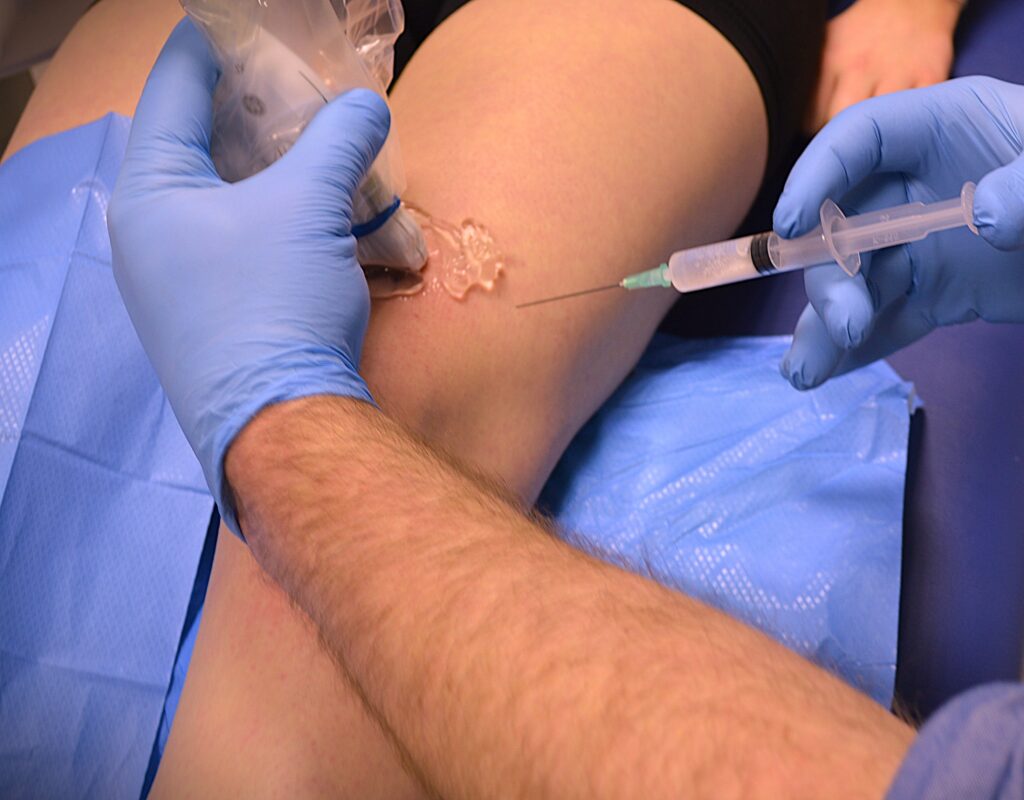
kneeinjecclose converted

Joint & Soft Tissue Injections

Joint and soft tissue injections can be really helpful in controlling and managing swelling and pain affecting a joint or soft tissue (bursa, nerve, tendon, ligament). These can be used in conjunction with rehabilitation and other treatments to help with movement, pain and restore the ability to exercise. Pain and swelling often limit the progression of rehabilitation and an injection of steroid (cortisone) combined with a local anaesthetic can remove that barrier and allow you to move pain free. This provides a helping hand in progressing with exercise.

Steroid Injection
Steroid injections
Steroid (Cortisone) is a powerful anti-inflammatory and stops the transport of fluid across the membrane by vasoconstriction (closure) of the small and local blood vessels. In the case of joint inflammation and synovitis, it will stop the process of inflammation allowing the body to remove any excess fluid and calm the area, reducing pain and enabling movement. This is helpful in osteoarthritic joints or in bursas and around tendons. The pain causes abnormal movement patterns placing more aggravation on the tissue or it causes painful compression of the tendon causing pain whenever you load. A joint injection will restore movement and enable the correct pattern of movement, such as walking without a limp. Reducing pain will allow the muscles to recover and the tissues to regain their load tolerance, reducing the likelihood of a recurrence of pain.
Where can i have an injection?
Injections can be used in number of conditions listed, but not limited to, below:
When joints and tendons become degenerative, their concentration of hyaluronic molecules reduces. Hyaluronic molecules provide our joints and tendons with tolerance to compression and load. Without hyaluron, we are vulnerable to injury, pain and further tissue damage. Hyaluronic acid injections work by increasing the concentration and molecular weight of hyaluron within the joint or around the tendon. This helps to reduce inflammation, increase viscosity, enhance gliding and decrease pain. Hyaluronic acid may be of consideration as an alternative to steroid or can be used in combination with steroid. If you have had a steroid injection and either had limited or no benefit, then a hyaluronic acid injection is the next treatment.
The major benefit of Hyaluronic acid injections is that they can help reduce joint inflammation by lowering the levels of harmful inflammatory substances and enzymes that break down cartilage tissue. These treatments may also stimulate the joint’s own cells to produce more natural lubricating compounds, potentially helping to restore and maintain healthy cartilage structure
We use a range of industry-leading hyaluronic injections: Sinovial, Sinogel, Durolane, Ostenil, Cignal and Monovisc. We do find that Sinovial and Sinogel are the most fast acting injection and we will offer this as our first line and novel injection. However, if you have had a different injection with good outcomes then we tend to advise to stick with the same injection and we will make this available to you, as you are highly likely to benefit again.

This injection is for those patients who have mild to moderate osteoarthritis, who want to continue leading an active life and who may not be having the longevity of hyaluronic acid alone. Sinogel is a long acting injection providing additional stability and durability when injected into the knee.

What is Sinogel?

Sinogel contains sodium hyaluronate and sodium chondroitin in a hybrid cooperative complex. It’s a proven treatment for osteoarthritis and similar degenerative conditions of large joints such as the hips. This combination represents an innovative approach that goes beyond traditional single-component hyaluronic acid injections.

What can I expect

We usually find that the knee responds after 7 days and then a further 6 weeks to find maximum benefits.

Aftercare

Unlike other hyaluronic acids, this unique injection can give rise to some stiffness for up to 72 hours. This reaction is thought to be prompted by the presence of sodium chondratin as the joint begins its regenerative process. We recommend a period of rest during this time.

How Sinogel Works
The treatment addresses the root cause of osteoarthritis pain at the joint level. In osteoarthritis, the synovial fluid which cushions the bones where they meet at joints tends to be lost or becomes too thin, which leads to pain and stiffness.
Hyaluronic acid is similar to a substance that occurs naturally in the joints. It works by acting like a lubricant and shock absorber in the joints and helps the joints to work properly. The addition of sodium chondroitin in Sinogel’s formulation may provide additional benefits for cartilage health and joint function.
Treatment Benefits
The effectiveness of Sinogel and similar hyaluronic acid treatments has been documented in clinical studies. Various scientific studies found it significantly reduces pain, restores mobility and quality of life for at least six months after the injection. This injection restores shock absorption in large joints (knee and hips joints), providing pain relief and improved joint mobility for people with osteoarthritis.
Recent research on hyaluronic acid treatments shows promising results. A 2023 study found that a majority of 166 patients who received one injection of a highly concentrated form of HA showed at least a 50% improvement in pain, stiffness and mobility, including walking, that lasted six months.
Who Benefits Most
They are generally most effective for patients with mild to moderate arthritis who have not found relief from medications, activity modification, or physical therapy. Hyaluronic acid injection is used to treat knee pain caused by osteoarthritis (OA) in patients who have already been treated with pain relievers (e.g., acetaminophen) and other treatments that did not work well.
Treatment Timeline and Duration
The effects don’t appear immediately. Benefits typically appear 4 to 6 weeks after treatment and can last up to 6 months; injections can be repeated if pain returns. Some patients may experience longer-lasting effects, with effects generally lasting 6 to 12 months.
Safety Profile
Sinogel has demonstrated good tolerability in clinical studies. It has a very good tolerability profile, with only mild, transient, and easily managed, local injection-site reactions and absence of systemic reactions. The most common side effect is mild pain and swelling at the injection site that goes away on its own.
The type of injection will be determined after your assessment. As independent clinicians we must assess your condition fully to ensure we provide you with the most effective treatment for your condition and the most evidence based. We will be able to help you with this decision at your assessment. If you have a mildly degenerative condition then we might suggest hyaluronic acid as this provides good pain relief and keeps the joint healthier for longer. Steroid is a great anti-inflammatory and works fast. However, repeated use is not healthy for the joint and we recommend no more than 3 injections per year with at least 3 months between injections. If you have a painful impingement or rotator cuff pain syndrome then we would suggest steroid as this is often a single injection and followed by expert rehabilitation, the pain does not come back. Injections can be administered on the day of your assessment, or you can book directly for an injection if your diagnosis is known. We will always perform a scan prior to the injection to confirm the diagnosis.
Injections are combined with a local anaesthetic and this helps to reduce any pain associated with the injection. Local anaesthetic can last for a an hour or two depending on where it is placed. The steroid can remain in reducing quantaties for many weeks. These injections can be curative, though for longer term and more chronic problems they can last for 2-8 weeks. Rehabilitation and continued treatment is best practice to ensure you achieve lasting results.
If you have a Frozen shoulder then a procedure called hydrodilatation can be highly effective in enabling movement.
Frozen shoulder has three phases. Freezing, characterised by a sudden onset of pain and limited movement. Here, we would generally inject with steroid as it is an inflammatory phase. The next phase is Frozen, where the joint is very stiff and difficult to move. Here, the joint has shrunk and become stiff. In order to regain movement a method used is hydrodilatation where by a large volume injection of saline, together with steroid, is placed into the capsule under ultrasound guidance with the additional fluid working to stretch the joint capsule and restore movement. This is highly effective and quickly advances the condition to its 3rd phase – โ€˜thawingโ€™ – where pain is reduced and movement slowly returns. In this phase manual therapy and exercise are highly effective in rehabilitating the shoulder back to normal.
The mechanism of action sets Arthrosamid apart from other treatments. Arthrosamid has the same effect of thickening the synovial membrane, which helps restore the joint’s natural cushioning properties. This approach addresses the underlying problem in osteoarthritis where cartilage breakdown leads to joint deterioration and pain.
Clinical Effectiveness and Timeline

The treatment shows impressive clinical results with rapid onset of benefits. Patients often experience decreased pain levels within just four weeks, allowing for improved mobility. Clinical studies show a high success rate of more than 70%, with most patients experiencing significant pain reduction and improved mobility.

Long-Term Benefits
One of Arthrosamidโ€™s most compelling advantages is its durability. Clinical studies have demonstrated sustained effectiveness over extended periods:

Remarkably, A growing number of anecdotal cases in Denmark report that many patients, 5-8 years post-treatment are still experiencing positive effects.

Treatment Procedure

Arthrosamidยฎ is administered via a simple, one-step procedure performed under local anaesthesia. Arthrosamid is a one-time injection designed to provide long-lasting relief from knee osteoarthritis pain. The procedure is performed as an outpatient treatment without the need for surgery.

Safety Profile

The safety profile of Arthrosamid is well-established through clinical research. Most patients experience mild to moderate pain or swelling at the injection site, which typically subsides quickly. While Arthrosamid is generally safe, some patients may experience mild swelling, redness, or discomfort at the injection site. These effects are usually short-lived.

Clinical Research Foundation

Supported by more than two decades of research, Arthrosamidยฎ is proven to be safe and effective, offering long-lasting pain relief in a single non-biodegradable injectable polyacrylamide hydrogel (2.5 iPAAG) for knee OA patients. A total combined number of 463 patients’ outcomes were reported and assessed. Statistically significant data was identified in two studies at both 52 weeks and 13 months.

Who Is a Good Candidate

Arthrosamid injections are a new non-surgical treatment for severe knee osteoarthritis. They are performed as a simple outpatient procedure, without the need for surgery. This makes it particularly appealing for patients seeking alternatives to surgery or those who haven’t found adequate relief from traditional treatments. In general, moderate Osteoarthritis is seen as the most successful grading of joint disease. In more advanced cases, there is clear benefit though the return to pre OA levels of activity may not be achievable

Comparison to Other Treatments

Comparative studies suggest Arthrosamid may offer superior pain relief and improved function over traditional hyaluronic acid treatments. While traditional treatments often require repeated injections every 6-12 months, Arthrosamid’s non-biodegradable nature means it can provide benefits for years from a single treatment.

Investment in Quality of Life

The cost of Arthrosamid is significantly more than other treatments, though it is a cost-effective investment in long-term quality of life for those with knee osteoarthritis. When considering the potential for years of pain relief from a single injection compared to repeated treatments with other therapies, many patients find it represents good value for improving their daily functioning and mobility.

Arthrosamid represents a significant advancement in osteoarthritis treatment, offering hope for patients seeking effective, long-term pain relief without the risks and recovery time associated with surgery. As with any medical treatment, consultation with a qualified healthcare provider is essential to determine if Arthrosamid is appropriate for your specific condition and circumstances.

Are there any risks to having an injection?

Joint and soft tissue injections carry a below 1% chance of infection and some patients are allergic to local anaesthetic, which is also very rare. Our clinicians assess whether it is sae for you and explain all of the risks prior to the injection. We ensure you are fully consented to the injection and you are informed about the risks and benefits of this treatment.

How do I book for an injection?

If you have a known condition then you can contact the clinic or book online for an injection assessment. If you think you may benefit from an injection but you are not sure then please call or email the clinic. You will still need to have an assessment. In some cases we can plan to book you in and have the injection ready for the day provided that assessment and safety parameters are satisfied. If you are rebooking for an injection and you are a known patient of the clinic or if you have had an injection at another practice, we will still assess for any risks to the injection, these can often be booked in online or over the phone.