
Joint & Soft Tissue Injections
Joint injections at our Reading clinic form part of a clinically structured treatment pathway rather than a standalone procedure. Persistent joint pain that has not responded to physiotherapy, activity modification, or medication often has an identifiable structural or inflammatory cause that responds well to targeted injection therapy. At Core Body Clinic, we identify the cause before selecting the injection type, the precise anatomical target, and the most appropriate timing within your overall treatment plan.
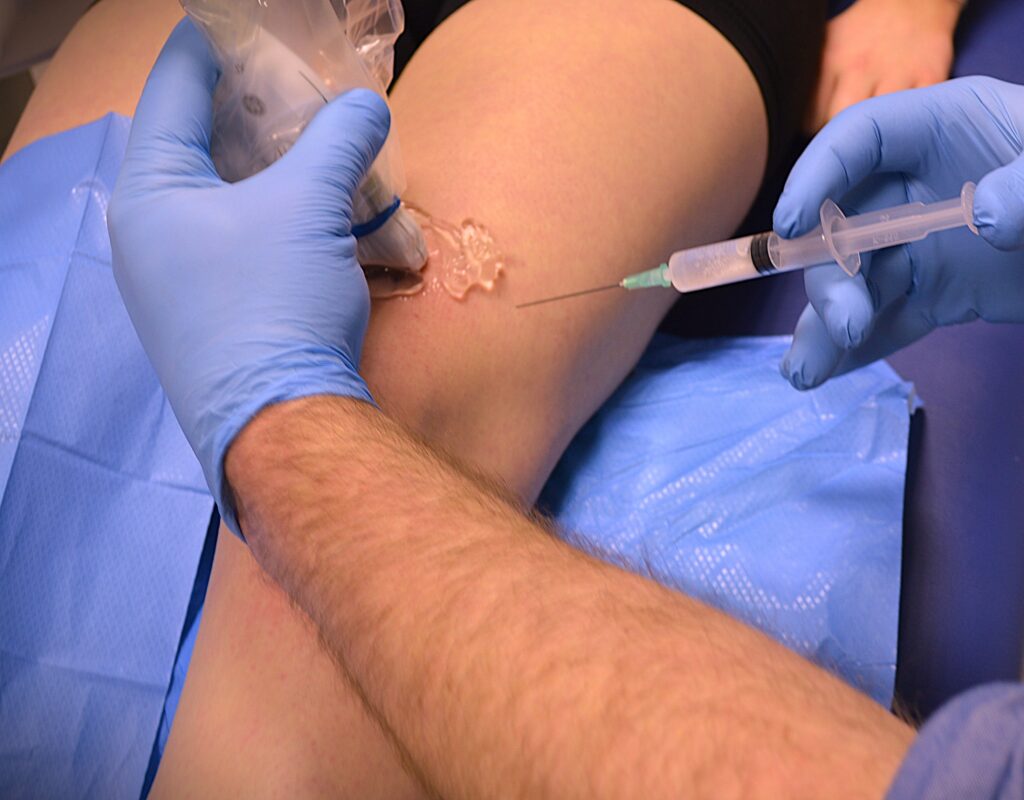
We offer the full range of injection therapies available at an advanced practice physiotherapy level. All injections are performed under ultrasound guidance, meaning the needle placement is visualised in real time. This eliminates the guesswork associated with landmark-guided injections and significantly improves accuracy, safety, and patient outcomes.
Steroid Injection
Steroid injections
Corticosteroid (cortisone) injections deliver a powerful anti-inflammatory agent directly into the affected joint, bursa, or soft tissue structure. At the cellular level, corticosteroids suppress the production of inflammatory mediators, including prostaglandins and cytokines, interrupting the inflammatory cascade that drives pain, swelling, and tissue sensitivity. This is distinct from systemic anti-inflammatory medication, which distributes throughout the body and carries a broader side effect profile. A targeted joint injection concentrates the anti-inflammatory effect precisely where it is needed.
When joint inflammation or synovitis is present, the joint capsule fills with excess fluid, restricting movement and placing abnormal compressive load on the surrounding soft tissue. Pain alters movement mechanics, generating compensation patterns that place further strain on adjacent structures. A well-placed steroid injection addresses this chain of events by reducing capsular inflammation, allowing the joint to decompress and the patient to move through a more normal range of motion. Rehabilitation then progresses without the mechanical barrier that pain creates.
WHICH CONDITIONS ARE SUITABLE FOR STEROID INJECTION?
Steroid injections at our Reading clinic are used for a range of inflammatory and compressive joint conditions, including but not limited to:
- Knee Osteoarthritis
- Hip OA
- Shoulder pain: Impingement, rotator cuff pain
- Frozen Shoulder
- Thumb arthritis
- Tennis and Golfers elbow
- Carpal Tunnel syndrome
- Some tendinopathies
- ITB Syndrome
- Hand and finger arthritis
- Bursitis
- Trigger finger / Trigger thumb
Steroid injections are most effective when combined with a structured rehabilitation programme. We recommend no more than three injections per year per joint, with a minimum of three months between each injection to protect the structural integrity of the joint.
Hydrodilatation for Frozen Shoulder
Frozen shoulder (adhesive capsulitis) is a condition defined by progressive fibrosis and contraction of the glenohumeral joint capsule, resulting in pain and severe restriction of shoulder movement in all directions. The condition progresses through three recognised clinical phases, each requiring a different management approach.
The Freezing phase is characterised by acute, often severe shoulder pain with progressively worsening stiffness. At this stage, the predominant process is inflammatory, and a steroid injection directly into the glenohumeral joint reduces capsular inflammation, manages pain, and slows the rate of capsular contraction.
The Frozen phase involves a significantly contracted and thickened joint capsule with a restricted range of motion in all planes. At this stage, hydrodilatation is the most clinically appropriate intervention. A large volume injection of saline combined with steroid is administered directly into the contracted joint capsule under ultrasound guidance. The hydraulic pressure generated stretches the capsule, mechanically disrupting the fibrotic adhesions and rapidly restoring joint volume. Most patients experience immediate improvement in range of motion following the procedure, advancing the shoulder towards the third phase of recovery.
The Thawing phase follows successful intervention. Pain levels reduce and movement gradually returns. At this stage, manual physiotherapy and a progressive exercise programme become the primary treatment tools, restoring full function and preventing recurrence.
Hydrodilatation at our Reading clinic is performed under real-time ultrasound guidance, ensuring precise capsular placement and maximising the therapeutic pressure generated. All patients are assessed before the procedure to confirm the stage of frozen shoulder and determine the most appropriate combination of agents to inject.
Sinogel Joint Injections
Sinogel is a hybrid injectable combining sodium hyaluronate and sodium chondroitin in a cooperative complex formulation. This dual-component structure gives Sinogel distinct properties not achievable with single-component hyaluronic acid preparations. Sodium hyaluronate provides immediate lubrication and viscosupplementation within the joint space. Sodium chondroitin adds structural durability and supports cartilage matrix integrity, providing a protective effect on articular cartilage that standard HA alone does not deliver.
WHAT IS SINOGEL?
Sinogel is indicated for patients with mild to moderate osteoarthritis who wish to maintain an active lifestyle and who require longer-lasting joint support than standard hyaluronic acid injections provide. It is particularly well-suited to larger joints, including the knee and hip, where load-bearing demands are high and sustained lubrication is critical to daily function.
WHAT CAN I EXPECT?
The knee typically begins responding within 7 days of injection. Maximum clinical benefit is usually reached at 6 weeks. The dual-component formulation provides sustained relief over a longer period than single-agent HA, making it a preferred option for patients who have found the duration of standard HA inadequate.
AFTERCARE
Sinogel may cause temporary stiffness lasting up to 72 hours following injection. This response reflects the presence of sodium chondroitin, initiating its regenerative action within the joint tissue. We advise a period of reduced activity during this window. The stiffness resolves without intervention and is not a sign of complication.
HOW SINOGEL WORKS
In osteoarthritis, synovial fluid loses both its volume and its biochemical complexity. Standard HA replaces lost lubrication. Sinogel goes further by restoring lubrication and providing chondroitin-mediated support to the cartilage matrix. Chondroitin sulphate inhibits the degradative enzymes that break down cartilage tissue in arthritic joints, providing a structural protective effect alongside the viscosupplementation that hyaluronic acid delivers. The combination targets the joint environment more comprehensively than either agent used alone.
TREATMENT BENEFITS
Clinical studies on Sinogel and comparable hyaluronic acid treatments consistently demonstrate significant reductions in pain, restoration of mobility, and improved quality of life sustained for a minimum of six months. Sinogel’s tolerability profile is excellent, with only mild, transient injection-site reactions reported and no systemic effects.
WHO BENEFITS MOST
Sinogel is most appropriate for patients with mild to moderate osteoarthritis who remain physically active, who have experienced limited longevity from standard HA, or who are seeking a more durable viscosupplementation option before considering surgical intervention.
TREATMENT TIMELINE AND DURATION
Initial response typically within 7 to 14 days. Maximum benefit at 6 weeks. Duration of effect ranges from 6 to 12 months, depending on disease severity and activity level. Repeat injection is safe and appropriate when symptoms return.
SAFETY PROFILE
Sinogel carries an excellent tolerability profile across clinical study populations. Local injection-site reactions are mild, transient, and self-resolving. Systemic reactions are not reported. The most common side effect is mild soreness and temporary stiffness at the injection site, both of which resolve within 72 hours.
Choosing the Right Injection for Your Condition
The appropriate injection is never determined by symptom description alone. All patients at our Reading clinic undergo clinical assessment before any injection is selected. Where diagnosis is not already confirmed, we perform a diagnostic ultrasound scan at the same appointment to visualise the affected structure in real time.
Selection follows a structured clinical rationale. Steroid injection suits acute inflammatory conditions, including bursitis, impingement, and synovitis. Sinogel addresses degenerative joints requiring longer-lasting viscosupplementation beyond what a steroid alone provides. Hydrodilatation is the primary intervention for frozen shoulder in the contracted phase.
Injections can be performed on the day of assessment where appropriate. All injections include a local anaesthetic to minimise discomfort, with the effect lasting one to two hours. Therapeutic benefit develops over 2 to 8 weeks for chronic conditions. Combining injection therapy with physiotherapy and rehabilitation produces the most durable long-term outcomes.
Joint Injections at Our Reading Clinic
Core Body Clinic’s Reading clinic at The Atrium, Scours Lane, RG30 6AY is fully equipped to deliver the complete range of joint injection therapies detailed on this page. Advanced practice physiotherapists perform all injections under ultrasound guidance in a dedicated clinical environment. We accept all major private medical insurance providers and welcome self-funding patients. Pricing is available on our price list page.
No GP referral is required. Book your assessment online or call 01792 369535.
What should I expect at my first injection appointment in Reading?
Your first appointment begins with a clinical assessment to confirm your diagnosis. Where imaging is needed, we perform an ultrasound scan at the same visit. Your clinician then selects the most appropriate injection type, explains the procedure, and administers the injection under ultrasound guidance. The appointment typically lasts 45 to 60 minutes. Most patients return to normal activity within 24 to 48 hours.
How do I know which injection is right for my condition?
This is determined at your clinical assessment based on your diagnosis, the severity and duration of your condition, your response to any previous treatments, and your functional goals. Our clinicians follow a structured decision-making process rather than defaulting to a single injection type for all presentations.
How long will the injection last?
Duration varies by injection type and condition severity. Steroid injections typically provide relief for 2 to 8 weeks for chronic conditions, though acute inflammatory presentations may resolve permanently following a single injection combined with rehabilitation. Sinogel injections commonly last 6 to 12 months.
Are joint injections covered by private medical insurance?
We are recognised by all major private medical insurance providers. We recommend contacting your insurer before your appointment to confirm your policy covers the specific injection type you require. Self-funding patients are also welcome, and full pricing is available on our website.
Is there any recovery time after a joint injection?
Most patients experience minimal downtime. Some soreness or temporary stiffness at the injection site is normal within the first 24 to 48 hours. We recommend avoiding strenuous activity on the day of the injection. Sinogel may cause stiffness for up to 72 hours due to the chondroitin component initiating its regenerative effect. Your clinician will provide specific aftercare guidance based on the injection administered.