
If your shoulder has become painful, stiff and difficult to move, especially when reaching overhead, behind your back or across your body, you may be dealing with frozen shoulder.
So, what is a frozen shoulder? Frozen shoulder, also called adhesive capsulitis, is a condition where the capsule around the shoulder joint becomes inflamed, thickened and tight. This can make normal shoulder movement painful and restricted.
It can be frustrating because it rarely behaves like a simple muscle strain. Rest alone often does not fix it; forcing movement can make symptoms worse, and recovery usually happens gradually.
With a clear assessment and a plan matched to your stage, symptoms can often be managed while movement slowly improves.
What Happens Inside the Shoulder?
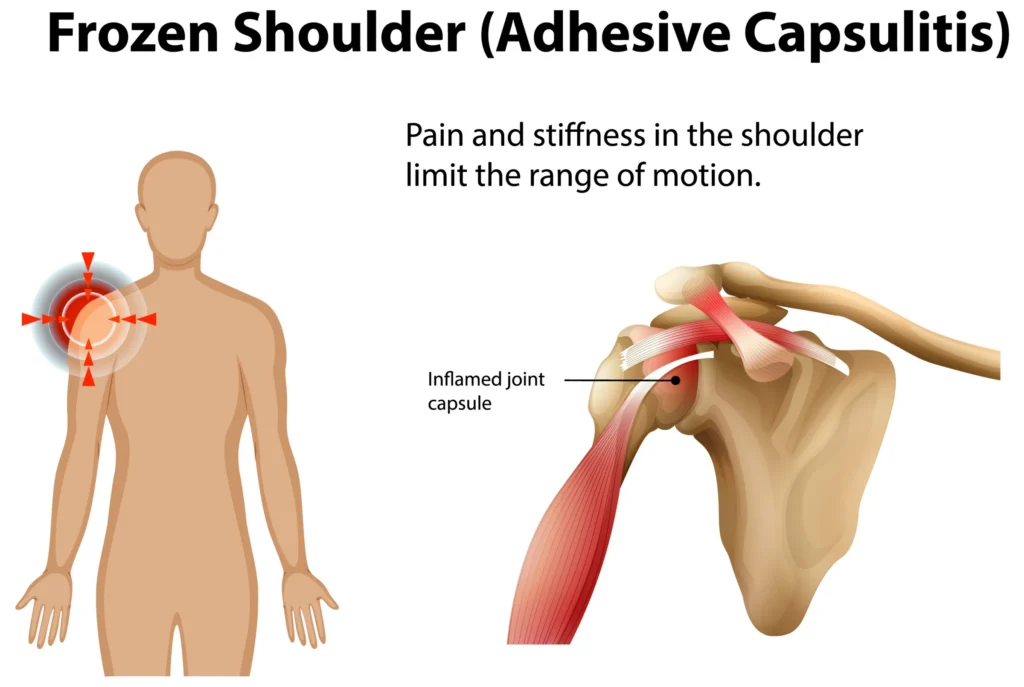
A strong capsule of connective tissue surrounds the shoulder joint. In frozen shoulder, this capsule becomes irritated and less flexible. Over time, it can tighten and limit the normal glide of the joint.
That is why frozen shoulder can feel different from general shoulder pain. You are not simply “tight”. The joint itself may be restricted.
A useful clinical clue is that both active and passive movement are limited. In simple terms, you struggle to move the arm yourself, and someone else would also struggle to move it for you.
If your symptoms are not clearly frozen shoulder, we would also consider other causes of shoulder pain, such as rotator cuff irritation, tendon problems, joint stiffness or referred pain.
Common Symptoms of Frozen Shoulder
Frozen shoulder symptoms vary, but most people notice pain, stiffness and reduced function.
Common signs include:
- A deep ache around the shoulder or upper arm
- Pain that is worse at night or when lying on the affected side
- Difficulty reaching overhead
- Trouble reaching behind your back
- Pain when putting on a coat, washing your hair or reaching for a seat belt
- Gradual loss of shoulder movement
- Stiffness that does not ease quickly with rest
The NHS guide to frozen shoulder explains that the main symptoms are shoulder pain and stiffness, and that symptoms can last for months or sometimes years.
Frozen shoulder usually develops gradually. If your pain started suddenly after a fall, heavy lift or sharp injury, it is important to rule out other causes first.
What Causes Frozen Shoulder?
Sometimes, frozen shoulder appears without a clear reason. In other cases, it may develop after a period where the shoulder has not moved normally, such as after injury, surgery or prolonged pain.
Certain health factors are also linked with a higher risk, including diabetes and thyroid problems. Medical guidance on adhesive capsulitis notes that inflammation, fibrosis and tightening of the shoulder capsule are key features of the condition. It also highlights risk factors such as diabetes, thyroid disorders, prolonged immobilisation and previous shoulder injuries.
Having risk factors does not mean you will definitely develop frozen shoulder. It simply means your wider health history should be considered during assessment.
The Three Stages of Frozen Shoulder
Frozen shoulder is often described in three stages: freezing, frozen and thawing. These stages are helpful, although symptoms can overlap.
| Stage | What You May Notice | Main Treatment Focus |
| Freezing stage | Increasing pain, night pain and movement becoming harder | Calm pain and protect comfortable movement |
| Frozen stage | Stiffness becomes the main issue, while pain may ease slightly | Restore range gradually and maintain strength |
| Thawing stage | Movement slowly improves, and pain usually settles | Build function, strength and confidence |
Stage 1: The Freezing Stage
This is often the most painful phase. The shoulder may ache at rest, hurt at night and become increasingly uncomfortable with reaching movements.
The temptation is to stretch hard because the shoulder feels tight. We understand the logic, but this can irritate the joint further. The aim is often to reduce pain, maintain comfortable movement and avoid unnecessary guarding.
Stage 2: The Frozen Stage
During the frozen stage, pain may reduce, but stiffness becomes more obvious. You may find that your shoulder simply will not move where you want it to.
This is when everyday tasks can become awkward, from reaching a shelf to fastening clothing. Treatment may gradually place more emphasis on movement, strength and function, but still within sensible limits.
Stage 3: The Thawing Stage
In the thawing stage, movement gradually returns. Pain may still come and go, especially when you challenge new ranges of movement.
At this stage, rehab often focuses on rebuilding shoulder control, strength and confidence so you can return to normal activities without constantly protecting the arm.
How Frozen Shoulder Is Diagnosed
Frozen shoulder is usually diagnosed through a clinical assessment. We would look at your symptoms, health history, shoulder movement, strength and the pattern of restriction.
A good assessment should consider:
- How your symptoms started
- Which movements are limited
- Whether pain or stiffness is the main issue
- Whether both active and passive movement are restricted
- Whether another shoulder problem may be involved
In a clinical assessment, we would usually look at how far the shoulder moves in different directions, what brings on your pain, and whether the neck, upper back or rotator cuff may also be involved. This helps guide treatment more accurately rather than assuming every stiff shoulder has the same cause.
Imaging is not always needed for suspected frozen shoulder. NICE guidance on managing frozen shoulder focuses on clinical assessment, pain management, maintaining movement and referral where symptoms are severe, persistent or unclear.
You can also read more on our dedicated frozen shoulder page for a condition-specific overview.
Frozen Shoulder Treatment Options
Frozen shoulder treatment works best when it matches the stage of the condition, not just the name of the diagnosis.
Treatment should be based on individual assessment, especially if you have diabetes, a recent injury, severe night pain, unexplained weakness or symptoms that are not improving.
1. Pain Relief and Activity Advice
In the painful stage, calming symptoms is often the priority. Your GP or pharmacist may advise pain relief such as paracetamol or anti-inflammatory medication if suitable for you.
Always follow the patient information leaflet or advice from a pharmacist, GP or prescribing clinician before taking medication.
Some people find the following adjustments useful, depending on their symptoms and clinical advice:
- Supporting the arm with a pillow when sleeping
- Avoiding repeated painful reaching
- Moving the shoulder gently within a comfortable range
- Using a wrapped heat pack if it feels helpful and your skin tolerates it
- Avoiding forceful stretching during high-pain phases, unless advised otherwise
This is not about wrapping the shoulder in cotton wool. It is about avoiding unnecessary flare-ups while keeping the shoulder moving within sensible limits.
2. Musculoskeletal Physiotherapy and Guided Exercise
Physiotherapy can play an important role in managing frozen shoulder, especially when your treatment is tailored to your stage. Early on, the focus may be pain control and comfortable movement. Later, treatment may shift towards range of movement, shoulder control and strength.
With our musculoskeletal physiotherapy service, we assess how your shoulder moves, what is limiting it and whether nearby areas, such as the neck, upper back or rotator cuff, may be contributing.
Depending on your assessment, a plan may include:
- Gentle mobility work
- Stage-appropriate stretching
- Strength exercises for the shoulder and surrounding muscles
- Advice on sleep, posture and daily movement habits
- Progressions for work, exercise or normal routines
The right level of movement is individual and may change over time. Too little movement can allow stiffness to dominate, while too much can flare symptoms.
If your shoulder feels stuck, painful or unpredictable, a structured physiotherapy assessment may help identify what is limiting your movement and what type of plan is most appropriate for your stage of recovery.

3. Corticosteroid Injections
A corticosteroid injection may be considered by an appropriately qualified clinician when pain is limiting sleep, movement or rehabilitation. It is most commonly used to reduce inflammation and pain, particularly in the earlier stages.
An injection may create a window where movement and physiotherapy become more tolerable, but it should usually be considered as part of a wider management plan. Where appropriate, our joint injections service may be discussed as one option within that plan.
4. Hydrodilatation and Surgery
Hydrodilatation, sometimes called capsular distension, involves injecting fluid into the shoulder joint to stretch the tight capsule. It is usually performed with image guidance and may be considered in some cases when stiffness is significant.
Many cases of frozen shoulder are managed without surgery, but persistent or complex cases may need specialist review. Surgical options, such as manipulation under anaesthetic or arthroscopic capsular release, are usually reserved for cases that have not improved with suitable non-surgical care.
What Should You Avoid?
A few common mistakes can slow progress or make symptoms harder to manage.
Try to avoid:
- Ignoring persistent shoulder stiffness for months
- Forcing painful stretches in the early stage
- Stopping all shoulder movement completely
- Assuming every stiff shoulder is frozen shoulder
- Relying on passive treatment without a home plan
- Comparing your recovery timeline with someone else’s
Frozen shoulder is slow by nature. That does not mean you should just wait and hope. It means treatment should be measured, consistent and matched to the stage you are in.
When Should You Get Help?
You should seek clinical advice if shoulder pain and stiffness are not settling, if pain is disturbing your sleep, or if you are losing movement and function.
You should also get assessed sooner if symptoms followed an injury, or if you have marked weakness, pins and needles, unexplained swelling, fever, chest symptoms or severe pain that feels unusual for you.
A proper assessment helps confirm whether the problem is frozen shoulder or another cause of shoulder pain.
In Summary
Frozen shoulder is a painful and stiff shoulder condition where the joint capsule becomes inflamed, thickened and tight. It usually progresses through freezing, frozen and thawing stages, and recovery can take time.
The key takeaway is that stage matters. Early on, treatment often focuses on pain control and gentle movement. Later, the focus shifts towards restoring range, strength and function.
If you are dealing with a shoulder that feels stuck, painful or increasingly restricted, we can assess your shoulder and discuss suitable next steps. You can contact our team to arrange an assessment or ask which service may be most appropriate.
This article is for general information only and is not a substitute for individual clinical assessment or medical advice. If you have specific symptoms or concerns, please speak to a qualified healthcare professional.