
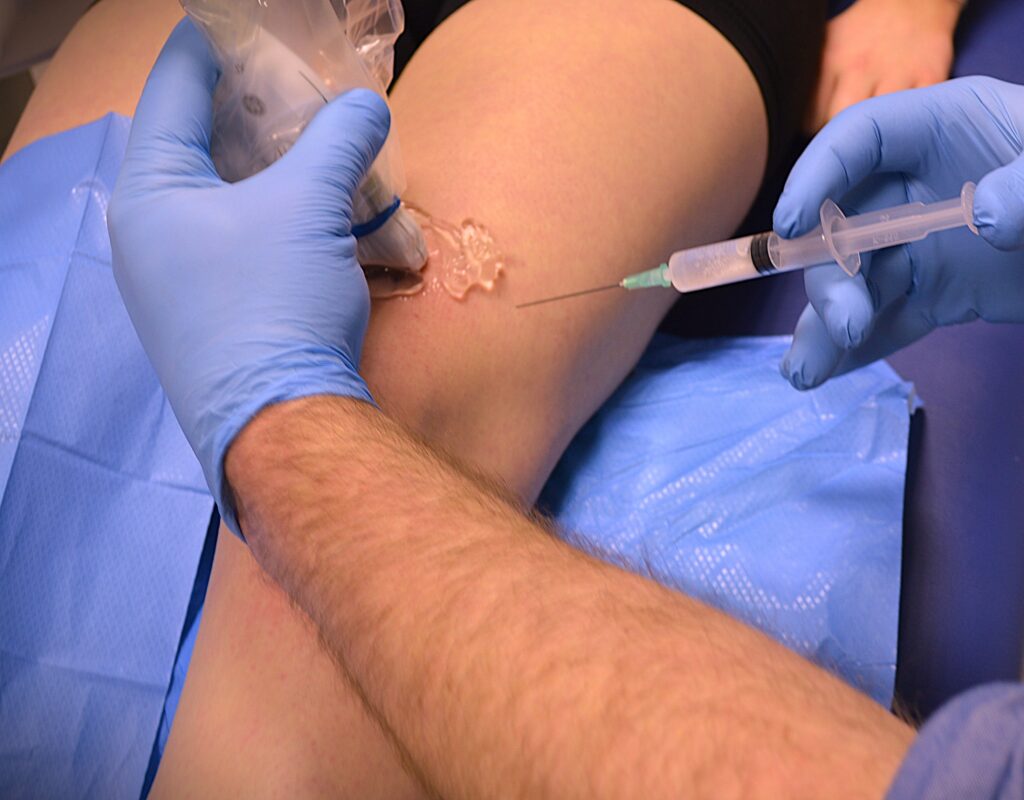
What Are Hyaluronic Acid Injections?
Hyaluronic acid is a naturally occurring substance found in healthy joint fluid, responsible for keeping the joint lubricated and cushioned during movement. In osteoarthritic joints, the concentration and quality of this fluid declines, reducing its ability to protect cartilage surfaces and causing increased friction, pain, and stiffness. Hyaluronic acid injection, also known as viscosupplementation, restores this lost lubrication by delivering a concentrated preparation directly into the joint under ultrasound guidance. This reduces inflammation, supports cartilage health, and helps restore the joint environment needed for comfortable movement. It can be used alongside physiotherapy and rehabilitation to improve function and allow you to return to the activities that matter to you.
How Hyaluronic Acid Injections Work
Understanding why hyaluronic acid injections are effective begins with understanding what goes wrong inside an osteoarthritic joint. The treatment works by directly addressing the biological changes that cause pain, stiffness, and cartilage deterioration, rather than simply masking symptoms.
The Role of Synovial Fluid in Joint Health
Synovial fluid in a healthy joint contains a high concentration of hyaluronic acid molecules with significant molecular weight and chain length. These properties give synovial fluid its characteristic viscosity, enabling it to absorb compressive load, distribute mechanical stress across the joint surface, and allow smooth, frictionless movement between articular cartilage surfaces.
What Happens in Osteoarthritic Joints
In osteoarthritic joints, both the concentration and molecular weight of hyaluronic acid decline significantly. The resulting fluid is thinner, less viscous, and far less capable of performing these protective functions. Mechanical friction increases, cartilage surfaces sustain greater wear, and the synovium responds with chronic low-grade inflammation that compounds the degenerative process.
How Viscosupplementation Addresses Joint Degeneration
Hyaluronic acid injection, known as viscosupplementation, addresses this directly. A concentrated, high molecular weight HA preparation is delivered into the joint space under ultrasound guidance. This immediately restores lubrication and load distribution within the joint. Over subsequent weeks, the injected HA also signals the joint’s own synoviocytes to upregulate endogenous HA production, extending the benefit beyond the initial viscosupplementation effect. Additionally, HA reduces the concentration of destructive inflammatory enzymes within the joint that accelerate cartilage matrix breakdown, providing a degree of chondroprotection alongside the mechanical benefits.
HA Preparations at Our Reading Clinic
At our Reading clinic, we use clinically validated HA preparations selected based on your specific joint condition severity and previous injection history. Our preferred first-line options are Sinovial and Sinogel due to their fast-acting profile, strong tolerability data, and dual-component formulation advantages. Where a patient has previously responded well to an alternative preparation, we continue with that product to maintain consistent benefit.
Clinical Evidence and Patient Selection
Treatment Benefits
The clinical evidence base for hyaluronic acid injection in osteoarthritis is substantial. A 2023 study of 166 patients receiving a single high-concentration HA injection demonstrated that the majority achieved at least a 50% improvement in pain, stiffness, and functional mobility sustained at six months. Across a broader body of literature, HA injection consistently reduces pain visual analogue scale scores, improves WOMAC functional outcomes, and delays the requirement for surgical intervention in appropriately selected patients.
Beyond pain reduction, HA injection has been shown to reduce concentrations of matrix metalloproteinases and other catabolic enzymes within the joint that drive cartilage degradation. This positions HA not merely as a symptomatic treatment but as a therapy with meaningful disease-modifying properties in the articular environment.
Who Benefits Most
Hyaluronic acid injection is most effective for patients with mild to moderate osteoarthritis who have not achieved adequate relief from physiotherapy, activity modification, or oral analgesia. It is particularly appropriate for patients who wish to remain physically active; those for whom long-term non-steroidal anti-inflammatory use is medically inadvisable; patients who have had a steroid injection with limited or short-lived benefit; and those seeking a well-established treatment appropriate across multiple joint types, including the knee, hip, shoulder, and ankle.
Patients who have previously responded well to HA injection are excellent candidates for repeat treatment. Repeat injection is both safe and clinically appropriate, and outcomes in patients with a documented prior response are reliably strong.
Treatment Timeline
Most patients notice the beginning of improvement within 4 to 6 weeks of injection. Full benefit is typically achieved by 8 weeks. Clinical relief commonly persists for 6 months, with a meaningful proportion of patients maintaining benefit for up to 12 months. Treatment can be repeated safely and predictably when symptoms return.
Safety Profile
Hyaluronic acid injections are well tolerated across all patient populations. The most commonly reported side effect is mild localised soreness or transient stiffness at the injection site, typically resolving within 48 hours. Systemic reactions are rare. The safety record of HA injection across large-scale clinical studies is consistently strong, and the treatment is suitable for long-term, repeat use.
The Diagnostic Assessment at Our Reading Clinic
Hyaluronic acid injection is not administered without prior clinical assessment at our Reading clinic. The precise joint affected, the degree of cartilage loss, and the extent of synovial inflammation all influence which HA preparation is most appropriate, the precise anatomical target within the joint, and the expected treatment response. These variables cannot be determined from a symptom description or referral letter alone.
At The Atrium, our assessment includes a detailed clinical history, physical examination of the affected joint, and ultrasound imaging performed in-house at the same appointment. Ultrasound allows us to visualise the joint in real time, confirm the degree of synovial thickening or effusion, and guide the injection needle to the precise intra-articular target with accuracy that landmark-guided injection cannot replicate.
For patients with existing MRI or X-ray imaging, we review this alongside our ultrasound findings to build the most complete clinical picture before treatment begins. Patients who have previously received HA injections elsewhere can often proceed to treatment at their first appointment, provided their diagnosis is confirmed and no contraindications are identified.
Hyaluronic Acid Injections at Our Reading Clinic
Core Body Clinic’s Reading clinic at The Atrium, Scours Lane, RG30 6AY provides hyaluronic acid injections under ultrasound guidance by advanced practice physiotherapists. All patients are assessed before treatment. We accept all major private medical insurance providers and welcome self-funding patients. Full pricing is available on our price list page.
No GP referral is required. Book your clinical assessment online or call 01792 369535.
How is hyaluronic acid different from a steroid injection?
Steroid injections primarily reduce inflammation and typically provide relief over a period of weeks to a few months. Hyaluronic acid injections restore the lubricating properties of synovial fluid and, over time, stimulate the joint’s own production of hyaluronic acid. HA injections also reduce the concentration of enzymes that break down cartilage, providing a degree of joint protection that steroid injections do not. HA injections are generally more appropriate for patients seeking sustained relief and longer-term joint health.
How many injections will I need?
At our Reading clinic, we typically use single-injection high-concentration HA preparations. A single injection is sufficient for most patients, with benefit lasting 6 to 12 months. For patients who respond well, repeat injections can be administered safely when symptoms return. Where a multi-injection course is clinically indicated based on your presentation, we will discuss this at your assessment.
Can hyaluronic acid injections be used in joints other than the knee?
Yes. Hyaluronic acid viscosupplementation can be used across multiple joint types including the knee, hip, shoulder, and ankle. Suitability for each joint is confirmed at your clinical assessment based on your imaging findings and symptom history.
How quickly will I notice improvement?
Most patients begin to notice improvement within 4 to 6 weeks of injection. Full benefit is typically achieved by 8 weeks. If you have not noticed a meaningful change by 8 to 10 weeks, contact us to arrange a follow-up assessment.
Do I need a GP referral?
No referral is required. You can self-refer by booking your clinical assessment online or calling 01792 369535. We accept patients referred by GPs, consultants, and other healthcare professionals, and are recognised by all major private medical insurance providers.